Not all 3D printing filaments are created equal. While PLA and PETG are excellent for prototypes, decorative parts, and general-purpose printing, they begin to soften, warp, or fail structurally at temperatures that real-world industrial, automotive, aerospace, and medical applications routinely encounter.
High-temperature engineering filaments exist to solve that problem.
These materials retain their mechanical strength, dimensional stability, and chemical resistance at continuous operating temperatures that would destroy standard polymers. They are used in jet engine brackets, surgical instruments, chemical processing equipment, automotive under-hood components, and defense hardware — anywhere that failure is not an option.
This guide covers every major high-temperature filament category in detail: what it is, how it performs, what printer hardware it requires, and where it is best applied. Whether you are an engineer selecting a material for a production part, a maker upgrading your capabilities, or a buyer evaluating options, this is the reference you need.
Understanding the High-Temperature Filament Spectrum
Before diving into individual materials, it helps to understand how the high-temperature filament world is structured. Most manufacturers and engineers divide these materials into three tiers:
Engineering Grade — materials that outperform standard filaments but are still accessible on mid-range printers:
- PC (Polycarbonate)
- ASA (Acrylonitrile Styrene Acrylate)
- PA / Nylon (various grades)
- PVDF (Polyvinylidene Fluoride)
High Performance — materials that require dedicated hardware and careful process control:
- PSU (Polysulfone)
- PPSU (Polyphenylsulfone)
- PEI / Ultem (Polyetherimide)
Ultra Performance — the most demanding materials in FDM printing, requiring industrial-grade machines:
- PEEK (Polyether Ether Ketone)
- PEKK (Polyether Ketone Ketone)
Each tier up brings greater heat resistance, chemical resistance, and mechanical performance — but also greater cost, greater printer hardware requirements, and a steeper learning curve.
The Filaments: Full Breakdown
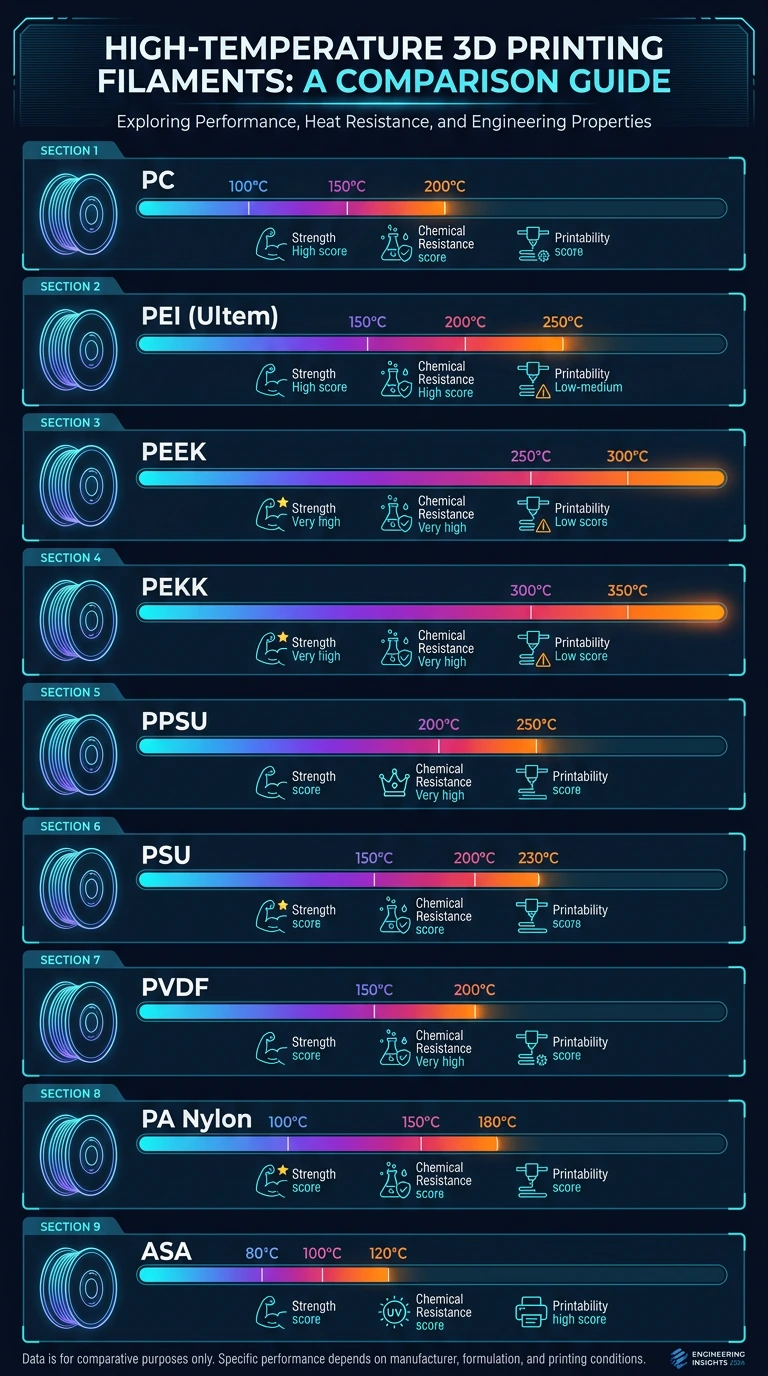
1. PC — Polycarbonate
Overview
Polycarbonate is the entry point into serious engineering-grade 3D printing. It is one of the toughest transparent thermoplastics available and offers a significant step up from ABS in both heat resistance and impact strength. PC is widely used in automotive lighting, electrical housings, safety equipment, and industrial tooling.
Full Specifications
|
Spec |
Value |
|
Nozzle Temperature |
260 – 310°C |
|
Bed Temperature |
90 – 120°C |
|
Chamber Temperature |
Recommended: 45 – 60°C |
|
Print Speed |
30 – 60 mm/s |
|
Continuous Use Temp |
Up to 135°C |
|
Glass Transition Temp (Tg) |
~147°C |
|
Tensile Strength |
55 – 75 MPa |
|
Flexural Strength |
80 – 100 MPa |
|
Impact Strength |
Very High (notched Izod: ~80 J/m) |
|
Density |
1.20 g/cm³ |
|
Chemical Resistance |
Moderate (poor vs. strong solvents) |
|
UV Resistance |
Moderate (degrades without UV stabilizer) |
|
Flame Rating |
UL 94 V-2 (standard) / V-0 (FR grades) |
|
Moisture Sensitivity |
High — must be dried before printing |
|
Drying Temp / Time |
80°C / 4–6 hours |
|
Nozzle Material |
Hardened steel recommended |
|
Difficulty Level |
Intermediate |
|
Approx. Cost per kg |
80 |
Strengths
Exceptional impact resistance — one of the toughest FDM materials
Good optical clarity in natural/transparent grades
Strong layer adhesion when printed correctly
Excellent dimensional stability
Weaknesses
Prone to warping without enclosure
Absorbs moisture aggressively — storage and drying are critical
Moderate chemical resistance — not suitable for strong solvents or acids
Requires higher nozzle temps than ABS
Best Applications
Automotive lighting components and lenses
Electrical enclosures and housings
Safety shields and protective covers
Functional prototypes requiring impact resistance
Jigs and fixtures for manufacturing
2. ASA — Acrylonitrile Styrene Acrylate
Overview
ASA is often described as the outdoor-ready version of ABS. It shares ABS's printability and mechanical profile but adds significantly better UV resistance and weatherability. For any application that will be exposed to sunlight, rain, or outdoor conditions, ASA is the preferred choice over ABS.
Full Specifications
|
Spec |
Value |
|
Nozzle Temperature |
240 – 280°C |
|
Bed Temperature |
90 – 110°C |
|
Chamber Temperature |
Recommended: 45°C |
|
Print Speed |
40 – 70 mm/s |
|
Continuous Use Temp |
Up to 98°C |
|
Glass Transition Temp (Tg) |
~100°C |
|
Tensile Strength |
40 – 55 MPa |
|
Flexural Strength |
65 – 80 MPa |
|
Impact Strength |
High (notched Izod: ~18 kJ/m²) |
|
Density |
1.07 g/cm³ |
|
Chemical Resistance |
Good (oils, dilute acids, alkalis) |
|
UV Resistance |
Excellent — superior to ABS |
|
Flame Rating |
UL 94 HB |
|
Moisture Sensitivity |
Moderate |
|
Drying Temp / Time |
80°C / 4 hours |
|
Nozzle Material |
Brass or hardened steel |
|
Difficulty Level |
Intermediate |
|
Approx. Cost per kg |
60 |
Strengths
Outstanding UV and weather resistance
Good surface finish and color retention outdoors
Similar printability to ABS
Good chemical resistance to oils and dilute chemicals
Weaknesses
Lower heat resistance than PC or higher-tier materials
Still prone to some warping without enclosure
Not suitable for structural high-heat applications
Best Applications
Outdoor signage and enclosures
Automotive exterior trim and mirror housings
Garden and agricultural equipment parts
Drone and RC vehicle bodies
Outdoor functional prototypes
3. PA — Polyamide (Nylon)
Overview
Nylon is one of the most versatile engineering filaments available. It combines excellent toughness, fatigue resistance, and self-lubricating properties with reasonable heat resistance. Multiple grades exist — PA6, PA12, PA6-CF, PA12-CF, PA-GF — each with different balances of strength, flexibility, and moisture sensitivity.
Full Specifications (PA12 — most common FDM grade)
|
Spec |
Value |
|
Nozzle Temperature |
240 – 270°C |
|
Bed Temperature |
70 – 90°C |
|
Chamber Temperature |
Recommended: 45°C |
|
Print Speed |
30 – 60 mm/s |
|
Continuous Use Temp |
Up to 100 – 130°C (grade dependent) |
|
Glass Transition Temp (Tg) |
~50°C (PA12) / ~60°C (PA6) |
|
Tensile Strength |
45 – 85 MPa (higher with CF/GF fill) |
|
Flexural Strength |
60 – 90 MPa |
|
Impact Strength |
Very High — excellent fatigue resistance |
|
Density |
1.01 – 1.14 g/cm³ |
|
Chemical Resistance |
Good (oils, fuels, alkalis) |
|
UV Resistance |
Poor (yellows without stabilizer) |
|
Flame Rating |
UL 94 HB (standard) / V-2 (FR grades) |
|
Moisture Sensitivity |
Very High — hygroscopic, must be dried |
|
Drying Temp / Time |
80°C / 6–8 hours |
|
Nozzle Material |
Hardened steel (especially CF/GF grades) |
|
Difficulty Level |
Intermediate to Advanced |
|
Approx. Cost per kg |
120 (CF/GF grades higher) |
PA Grade Comparison
|
Grade |
Tg |
Strength |
Moisture Absorption |
Notes |
|
PA6 |
~60°C |
High |
Very High |
Strongest, most hygroscopic |
|
PA12 |
~50°C |
Moderate |
Low |
Best printability, least moisture |
|
PA6-CF |
~60°C |
Very High |
High |
Stiff, abrasive — hardened nozzle required |
|
PA12-CF |
~50°C |
High |
Low |
Best balance of strength and printability |
|
PA-GF |
~55°C |
High |
Moderate |
Good stiffness, less abrasive than CF |
Strengths
Excellent fatigue and impact resistance
Self-lubricating — ideal for moving parts
Good chemical resistance to oils and fuels
Composite grades (CF/GF) offer exceptional stiffness
Weaknesses
Extremely hygroscopic — moisture ruins prints
Poor UV resistance in standard grades
Warps without proper bed adhesion and enclosure
CF/GF grades are highly abrasive on nozzles
Best Applications
Gears, bearings, and bushings
Cable management and snap-fit connectors
Automotive fuel system components
Prosthetics and orthopedic devices
Industrial tooling and wear parts
4. PVDF — Polyvinylidene Fluoride
Overview
PVDF is a specialty fluoropolymer that occupies a unique position in the high-temperature filament world. It is not the strongest or the hottest-rated material on this list, but it offers a combination of chemical resistance, piezoelectric properties, and radiation resistance that no other FDM material can match. It is the go-to choice for chemical processing, semiconductor manufacturing, and nuclear applications.
Full Specifications
|
Spec |
Value |
|
Nozzle Temperature |
220 – 260°C |
|
Bed Temperature |
80 – 100°C |
|
Chamber Temperature |
Recommended: 45°C |
|
Print Speed |
20 – 40 mm/s |
|
Continuous Use Temp |
Up to 150°C |
|
Glass Transition Temp (Tg) |
~-40°C (semi-crystalline) |
|
Melting Point |
~170°C |
|
Tensile Strength |
35 – 55 MPa |
|
Flexural Strength |
60 – 80 MPa |
|
Impact Strength |
Moderate |
|
Density |
1.78 g/cm³ |
|
Chemical Resistance |
Outstanding — resists most acids, bases, solvents |
|
UV Resistance |
Excellent |
|
Radiation Resistance |
Excellent |
|
Flame Rating |
UL 94 V-0 |
|
Moisture Sensitivity |
Low |
|
Drying Temp / Time |
65°C / 4 hours |
|
Nozzle Material |
Hardened steel |
|
Difficulty Level |
Advanced |
|
Approx. Cost per kg |
300 |
Strengths
Exceptional chemical resistance — one of the best in FDM
Excellent UV and radiation resistance
Piezoelectric properties (useful in sensors)
UL 94 V-0 flame rating
Low moisture absorption
Weaknesses
Lower tensile strength than PEEK or PEI
Difficult to print — poor layer adhesion without correct settings
High cost
Slow print speeds required
Best Applications
Chemical processing pipes, valves, and fittings
Semiconductor and cleanroom components
Nuclear and radiation-exposed parts
Fluid handling systems
Sensors and piezoelectric devices
5. PSU — Polysulfone
Overview
Polysulfone is a high-performance thermoplastic known for its transparency, rigidity, and excellent resistance to hydrolysis. It can withstand repeated steam sterilization cycles, making it valuable in medical and food processing applications. PSU sits between engineering-grade and ultra-performance materials in terms of both capability and cost.
Full Specifications
|
Spec |
Value |
|
Nozzle Temperature |
340 – 380°C |
|
Bed Temperature |
120 – 160°C |
|
Chamber Temperature |
Required: 70 – 90°C |
|
Print Speed |
20 – 40 mm/s |
|
Continuous Use Temp |
Up to 160°C |
|
Glass Transition Temp (Tg) |
~185°C |
|
Tensile Strength |
65 – 75 MPa |
|
Flexural Strength |
95 – 110 MPa |
|
Impact Strength |
Moderate |
|
Density |
1.24 g/cm³ |
|
Chemical Resistance |
Good (acids, alkalis, hydrocarbons) |
|
UV Resistance |
Moderate |
|
Flame Rating |
UL 94 V-0 |
|
Moisture Sensitivity |
Moderate |
|
Drying Temp / Time |
120°C / 4–6 hours |
|
Nozzle Material |
Hardened steel required |
|
Difficulty Level |
Advanced |
|
Approx. Cost per kg |
250 |
Strengths
Excellent hydrolysis resistance — survives steam sterilization
Good transparency in natural grade
Strong resistance to acids, alkalis, and hydrocarbons
UL 94 V-0 flame rating
Good dimensional stability
Weaknesses
Requires high nozzle temperatures and heated chamber
Moderate impact resistance compared to PPSU
Moderate UV resistance
Requires industrial-grade printer
Best Applications
Medical device housings and sterilizable components
Food processing equipment
Fluid handling and filtration systems
Electrical insulators and connectors
Automotive fluid system components
6. PPSU — Polyphenylsulfone
Overview
PPSU is the toughest member of the polysulfone family. It combines the heat and chemical resistance of PSU with dramatically improved impact strength and the ability to withstand more aggressive sterilization methods including autoclave, gamma radiation, and chemical disinfection. It is widely used in aerospace and medical applications where both toughness and sterilizability are required.
Full Specifications
|
Spec |
Value |
|
Nozzle Temperature |
360 – 400°C |
|
Bed Temperature |
140 – 180°C |
|
Chamber Temperature |
Required: 80 – 100°C |
|
Print Speed |
15 – 35 mm/s |
|
Continuous Use Temp |
Up to 180 – 200°C |
|
Glass Transition Temp (Tg) |
~220°C |
|
Tensile Strength |
55 – 70 MPa |
|
Flexural Strength |
90 – 110 MPa |
|
Impact Strength |
Very High — best in polysulfone family |
|
Density |
1.29 g/cm³ |
|
Chemical Resistance |
Superior — resists most disinfectants and sterilants |
|
UV Resistance |
Moderate |
|
Flame Rating |
UL 94 V-0 |
|
Moisture Sensitivity |
Moderate |
|
Drying Temp / Time |
120°C / 4–6 hours |
|
Nozzle Material |
Hardened steel required |
|
Difficulty Level |
Advanced |
|
Approx. Cost per kg |
350 |
Strengths
Highest impact strength in the polysulfone family
Withstands autoclave, gamma, and chemical sterilization
Excellent chemical resistance
UL 94 V-0 flame rating
Good dimensional stability at high temperatures
Weaknesses
Requires very high nozzle temperatures (up to 400°C)
Heated chamber is mandatory
Slower print speeds
Higher cost than PSU
Best Applications
Surgical instrument handles and medical device housings
Aerospace interior brackets and clips
Industrial chemical processing components
Sterilizable laboratory equipment
Defense and military hardware
7. PEI — Polyetherimide (Ultem™)
Overview
PEI, commercially known as Ultem (a SABIC trademark), is one of the most widely used high-performance filaments in aerospace and defense. It offers an excellent balance of heat resistance, flame retardancy, strength, and printability relative to PEEK. Two primary grades exist: Ultem 9085 (higher toughness, aerospace-certified) and Ultem 1010 (higher heat resistance, food and medical contact compliant).
Full Specifications
|
Spec |
Ultem 9085 |
Ultem 1010 |
|
Nozzle Temperature |
360 – 400°C |
370 – 420°C |
|
Bed Temperature |
140 – 160°C |
160 – 180°C |
|
Chamber Temperature |
Required: 80 – 90°C |
Required: 90°C |
|
Print Speed |
20 – 40 mm/s |
15 – 35 mm/s |
|
Continuous Use Temp |
Up to 170°C |
Up to 210°C |
|
Glass Transition Temp (Tg) |
~186°C |
~217°C |
|
Tensile Strength |
69 MPa |
81 MPa |
|
Flexural Strength |
110 MPa |
144 MPa |
|
Impact Strength |
High |
Moderate-High |
|
Density |
1.34 g/cm³ |
1.27 g/cm³ |
|
Chemical Resistance |
Good |
Excellent |
|
Flame Rating |
UL 94 V-0 |
UL 94 V-0 |
|
FST Compliance |
Yes (aerospace) |
Yes |
|
Moisture Sensitivity |
Moderate |
Moderate |
|
Drying Temp / Time |
120°C / 4–6 hours |
120°C / 4–6 hours |
|
Nozzle Material |
Hardened steel required |
Hardened steel required |
|
Difficulty Level |
Advanced |
Advanced |
|
Approx. Cost per kg |
500 |
600 |
Strengths
Inherent UL 94 V-0 flame resistance — no additives needed
Excellent FST (Flame, Smoke, Toxicity) compliance for aerospace
Good strength-to-weight ratio
More printable than PEEK at comparable performance levels
Ultem 1010 is food-contact and medical-contact compliant
Weaknesses
Requires industrial-grade printer with heated chamber
High cost
Slower print speeds
Requires very precise temperature control
Best Applications
Aerospace interior components (FAR 25.853 compliant)
Automotive under-hood parts
Electrical insulators and connectors
Medical device housings (Ultem 1010)
Defense and military hardware
8. PEEK — Polyether Ether Ketone
Overview
PEEK is the gold standard of FDM engineering polymers. It offers the highest continuous-use temperature of any commonly available FDM filament, combined with exceptional mechanical strength, chemical resistance, and biocompatibility. PEEK is used in the most demanding applications across aerospace, oil and gas, medical implants, and semiconductor manufacturing. It is also one of the most difficult and expensive materials to print correctly.
Full Specifications
|
Spec |
Value |
|
Nozzle Temperature |
380 – 450°C |
|
Bed Temperature |
120 – 200°C |
|
Chamber Temperature |
Required: 90 – 120°C |
|
Print Speed |
10 – 30 mm/s |
|
Continuous Use Temp |
Up to 250°C |
|
Glass Transition Temp (Tg) |
~143°C |
|
Melting Point |
~343°C |
|
Tensile Strength |
95 – 110 MPa |
|
Flexural Strength |
160 – 170 MPa |
|
Compressive Strength |
~120 MPa |
|
Impact Strength |
High |
|
Density |
1.30 – 1.32 g/cm³ |
|
Chemical Resistance |
Exceptional — resists almost all chemicals |
|
UV Resistance |
Good |
|
Biocompatibility |
Yes (medical grade) |
|
Flame Rating |
UL 94 V-0 |
|
Moisture Sensitivity |
Low |
|
Drying Temp / Time |
120°C / 4–6 hours |
|
Nozzle Material |
Hardened steel or ruby required |
|
Printer Requirement |
Industrial — nozzle up to 480°C, heated chamber |
|
Difficulty Level |
Expert |
|
Approx. Cost per kg |
1,200+ |
PEEK Composite Grades
|
Grade |
Key Benefit |
Tensile Strength |
Notes |
|
PEEK standard |
Baseline performance |
~100 MPa |
Most common |
|
PEEK-CF (Carbon Fiber) |
Higher stiffness, lower weight |
~130 MPa |
Abrasive — ruby nozzle |
|
PEEK-GF (Glass Fiber) |
Better dimensional stability |
~110 MPa |
Less abrasive than CF |
|
Medical PEEK |
Biocompatible, implant-grade |
~100 MPa |
ISO 10993 compliant |
Strengths
Highest continuous-use temperature in FDM (250°C)
Exceptional chemical resistance — survives almost all industrial chemicals
Biocompatible in medical grade
Outstanding mechanical strength
Excellent fatigue and wear resistance
Weaknesses
Requires the most demanding printer hardware
Very slow print speeds
Extremely high cost
Requires expert-level process knowledge
Warping and delamination risk without proper chamber control
Best Applications
Aerospace structural components and brackets
Oil and gas downhole tools and seals
Medical implants and surgical instruments
Semiconductor and cleanroom components
High-performance automotive parts
9. PEKK — Polyether Ketone Ketone
Overview
PEKK is often described as PEEK's more printable cousin. It offers comparable heat resistance and mechanical performance to PEEK but with a key processing advantage: PEKK has a slower crystallization rate, which reduces warping and makes it significantly easier to print on properly equipped machines. It is increasingly preferred in aerospace and defense applications where PEEK-level performance is needed but process reliability is critical.
Full Specifications
|
Spec |
Value |
|
Nozzle Temperature |
360 – 420°C |
|
Bed Temperature |
120 – 180°C |
|
Chamber Temperature |
Required: 90 – 120°C |
|
Print Speed |
15 – 35 mm/s |
|
Continuous Use Temp |
Up to 240°C (amorphous) / 260°C (semi-crystalline) |
|
Glass Transition Temp (Tg) |
~160°C (amorphous) |
|
Melting Point |
~305 – 360°C (grade dependent) |
|
Tensile Strength |
90 – 105 MPa |
|
Flexural Strength |
150 – 165 MPa |
|
Impact Strength |
High |
|
Density |
1.28 – 1.30 g/cm³ |
|
Chemical Resistance |
Excellent — comparable to PEEK |
|
UV Resistance |
Good |
|
Flame Rating |
UL 94 V-0 |
|
Moisture Sensitivity |
Low |
|
Drying Temp / Time |
120°C / 4–6 hours |
|
Nozzle Material |
Hardened steel or ruby required |
|
Printer Requirement |
Industrial — heated chamber mandatory |
|
Difficulty Level |
Expert (easier than PEEK) |
|
Approx. Cost per kg |
900 |
PEKK vs PEEK — Key Differences
|
Property |
PEEK |
PEKK |
|
Crystallization Rate |
Fast |
Slow |
|
Warping Risk |
Higher |
Lower |
|
Printability |
Harder |
Easier |
|
Continuous Use Temp |
250°C |
240 – 260°C |
|
Tensile Strength |
~100 MPa |
~95 MPa |
|
Cost |
Higher |
Slightly lower |
|
Aerospace Use |
Common |
Growing rapidly |
Strengths
Near-PEEK performance with better printability
Slower crystallization reduces warping significantly
Excellent resistance to fuels, hydraulic fluids, and thermal cycling
UL 94 V-0 flame rating
Strong aerospace and defense adoption
Weaknesses
Still requires industrial-grade printer
High cost
Slower print speeds
Expert-level process knowledge required
Best Applications
Aerospace structural and interior components
Defense hardware and field equipment
Fuel system and hydraulic fluid-exposed parts
High-temperature industrial tooling
Thermal cycling environments
Master Comparison Table
|
Material |
Nozzle Temp |
Bed Temp |
Chamber |
Print Speed |
Continuous Use Temp |
Tensile Strength |
Chemical Resistance |
Difficulty |
Cost/kg |
|
ASA |
240–280°C |
90–110°C |
Recommended |
40–70 mm/s |
98°C |
40–55 MPa |
Good |
Intermediate |
$25–60 |
|
PC |
260–310°C |
90–120°C |
Recommended |
30–60 mm/s |
135°C |
55–75 MPa |
Moderate |
Intermediate |
$30–80 |
|
PA (Nylon) |
240–270°C |
70–90°C |
Recommended |
30–60 mm/s |
100–130°C |
45–85 MPa |
Good |
Intermediate–Adv |
$40–120 |
|
PVDF |
220–260°C |
80–100°C |
Recommended |
20–40 mm/s |
150°C |
35–55 MPa |
Outstanding |
Advanced |
$150–300 |
|
PSU |
340–380°C |
120–160°C |
Required |
20–40 mm/s |
160°C |
65–75 MPa |
Good |
Advanced |
$100–250 |
|
PPSU |
360–400°C |
140–180°C |
Required |
15–35 mm/s |
180–200°C |
55–70 MPa |
Superior |
Advanced |
$150–350 |
|
PEI (Ultem) |
360–420°C |
140–180°C |
Required |
15–40 mm/s |
170–210°C |
69–81 MPa |
Excellent |
Advanced |
$200–600 |
|
PEKK |
360–420°C |
120–180°C |
Required |
15–35 mm/s |
240–260°C |
90–105 MPa |
Excellent |
Expert |
$350–900 |
|
PEEK |
380–450°C |
120–200°C |
Required |
10–30 mm/s |
250°C |
95–110 MPa |
Exceptional |
Expert |
$400–1,200+ |
Printer Hardware Requirements
High-temperature filaments are not just a material challenge — they are a hardware challenge. Here is what your printer needs to handle each tier:
Engineering Grade (ASA, PC, PA, PVDF)
Nozzle: Up to 300°C (all-metal hotend)
Bed: Up to 120°C
Enclosure: Strongly recommended
Nozzle material: Hardened steel for abrasive grades (CF/GF)
Compatible printers: Bambu X1E, Prusa MK4S with enclosure, Creality K1 Max, Raise3D Pro3
High Performance (PSU, PPSU, PEI)
Nozzle: Up to 420°C
Bed: Up to 180°C
Heated chamber: Required (70–100°C)
Nozzle material: Hardened steel mandatory
Compatible printers: Stratasys Fortus series, Raise3D Hyper series, 3DXTech 22 IDEX, AON3D
Ultra Performance (PEEK, PEKK)
Nozzle: Up to 480°C
Bed: Up to 200°C
Heated chamber: Required (90–120°C)
Nozzle material: Hardened steel or ruby
Annealing capability: Strongly recommended
Compatible printers: CreatBot PEEK-300, Intamsys FUNMAT HT Enhanced, AON-M2+, Apium P220
Filament Storage and Drying Guide
All high-temperature filaments are hygroscopic to varying degrees. Moisture absorbed from the air causes bubbling, stringing, poor layer adhesion, and structural weakness in finished parts. Proper storage and drying are non-negotiable.
|
Filament |
Drying Temp |
Drying Time |
Storage |
|
ASA |
80°C |
4 hours |
Sealed bag with desiccant |
|
PC |
80°C |
4–6 hours |
Sealed bag with desiccant |
|
PA (Nylon) |
80°C |
6–8 hours |
Sealed bag — very hygroscopic |
|
PVDF |
65°C |
4 hours |
Sealed bag with desiccant |
|
PSU |
120°C |
4–6 hours |
Sealed bag with desiccant |
|
PPSU |
120°C |
4–6 hours |
Sealed bag with desiccant |
|
PEI (Ultem) |
120°C |
4–6 hours |
Sealed bag with desiccant |
|
PEKK |
120°C |
4–6 hours |
Sealed bag with desiccant |
|
PEEK |
120°C |
4–6 hours |
Sealed bag with desiccant |
Pro tip: If you hear popping or crackling during printing, or see steam from the nozzle, your filament is wet. Stop the print, dry the spool, and restart.
Industry Applications by Filament
|
Industry |
Recommended Filaments |
|
Aerospace |
PEEK, PEKK, PEI (Ultem), PPSU |
|
Automotive |
PC, PA-CF, PEI, PEEK, ASA |
|
Medical / Surgical |
PEEK (medical grade), PEI 1010, PPSU, PSU |
|
Oil & Gas |
PEEK, PVDF, PPSU |
|
Defense |
PEKK, PEI, PPSU, PEEK |
|
Electronics / Semiconductor |
PEEK, PVDF, PEI |
|
Industrial Manufacturing |
PC, PA, PSU, PPSU |
|
Outdoor / Consumer |
ASA, PC |
|
Chemical Processing |
PVDF, PEEK, PSU |
|
Food & Beverage |
PEI 1010, PSU, PVDF |
How to Choose the Right High-Temperature Filament
Use this decision framework:
Step 1 — Define your operating temperature
Under 100°C → ASA or PA
100–140°C → PC or PA-CF
140–170°C → PEI (Ultem 9085) or PSU
170–210°C → PEI (Ultem 1010) or PPSU
210–260°C → PEEK or PEKK
Step 2 — Define your chemical exposure
Mild (oils, dilute acids) → PA, PC, ASA
Moderate (fuels, hydraulic fluids) → PEI, PEKK
Severe (strong acids, solvents) → PVDF, PEEK
Step 3 — Define your mechanical requirements
Impact-critical → PC, PA, PPSU
Stiffness-critical → PEEK-CF, PEKK, PEI
Fatigue-critical → PA, PEEK
Step 4 — Define your budget and hardware
Mid-range printer → ASA, PC, PA
High-performance printer → PSU, PPSU, PEI
Industrial printer → PEEK, PEKK
Final Thoughts
High-temperature 3D printing filaments represent the frontier of what additive manufacturing can achieve. From the accessible toughness of polycarbonate to the aerospace-grade performance of PEEK and PEKK, these materials have fundamentally changed what engineers can design, prototype, and produce without traditional machining.
The key to success with any of these materials is understanding that the filament is only part of the equation. Printer hardware, process control, drying discipline, and material selection all work together. Get those right, and high-temperature FDM printing can produce parts that compete directly with injection-molded and machined components in the most demanding environments on earth.