
What if your brand is posting consistently, designing stronger visuals, and publishing better content than ever, but still struggling to grow? In many cases, the problem is not content quality alone. The real issue is discoverability. If your business is hard to find across the web, difficult to verify, or inconsistently listed on trusted platforms, your social media growth and your SEO growth can both stall at the same time.
In 2026, brands do not grow online through a single channel. They grow through connected visibility. Your website, your social profiles, your business listings, your citations, your directory presence, your branded search results, and your backlink profile all work together. That is why link submission platforms still matter. Used correctly, they can help newer websites get discovered faster, help established brands strengthen authority, and support the kind of multi-channel presence that drives both search traffic and social credibility.
But there is an important distinction here. Link submissions are not a magic growth hack. They do not replace technical SEO. They do not replace content strategy. They do not replace real community-building on social media. What they do is support the foundation. They create trust signals, improve crawl paths, increase brand mentions, and help search engines understand that your company exists consistently across the internet.
For companies investing in social media marketing, this matters more than many teams realize. A stronger backlink and citation footprint can improve branded search visibility. Better branded search visibility can increase profile visits, referral traffic, and conversion confidence. When prospects see your company on trusted directories, reputable listings, and recognized platforms, your brand appears more established. That trust often translates into more clicks, more follows, and better conversion from social campaigns.
In this guide, we break down what link submission platforms actually do, what it takes to build an audience and backlinks at the same time, and which eight platforms are worth reviewing right now. We also included FreeWebSubmission.com as the eighth option, as requested, because it brings a slightly different angle through free submission and local search visibility.
Why Link Submission Still Matters in 2026
Link submission is one of the oldest ideas in SEO, but that does not make it outdated. It simply means the strategy has matured. Years ago, many businesses treated submissions as a volume game. They blasted their site to low-quality directories and hoped rankings would rise. That approach is exactly what search engines learned to ignore or distrust.
Today, the value of submissions comes from relevance, moderation, trust, and consistency. A high-quality listing on the right platform can help search engines verify your brand, understand your market, and connect your site with real business entities, industries, or regions. This is particularly useful for:
- new websites that need discovery and indexing support,
- local businesses building citation consistency,
- service companies expanding into new markets,
- brands launching social media campaigns that need more trust signals,
- businesses trying to strengthen branded search performance.
Think of it this way: a brand that only exists on its own website and social profiles looks isolated. A brand that also appears in business directories, niche catalogs, profile pages, local listings, and industry resources looks established. Search engines notice that. Users notice it too.
The Real Connection Between Backlinks and Social Media Growth
Many companies still separate SEO and social media into different departments, different dashboards, and different goals. That separation is increasingly artificial. Social media may not pass the same direct ranking value as a traditional backlink, but social presence absolutely influences how your brand is discovered, evaluated, and trusted.
When someone sees your company on Instagram, LinkedIn, Facebook, X, Threads, YouTube, or another channel, they often do not convert immediately. They search your brand name. They check your website. They compare your business across other listings. They look for signs that you are active, credible, and real.
That means your social media growth is reinforced by off-platform signals such as:
- consistent business name, address, and website information,
- profile backlinks from trustworthy platforms,
- brand mentions on directory and listing sites,
- local citations that validate your business identity,
- supporting content published across multiple web properties.
If your social content creates awareness, your broader web footprint closes the trust gap. That is where link submission platforms become useful. They help create the distributed digital presence that makes your brand easier to verify and easier to trust.
What It Really Takes to Build an Audience and Backlinks at the Same Time
If your goal is long-term audience growth, do not treat backlinks as isolated SEO trophies. Treat them as part of a broader brand visibility system. The strongest companies combine submissions, content, social proof, and engagement into one coordinated strategy.
Here is what that looks like in practice.
1. Start with brand consistency
Your website, social profiles, business listings, and submission pages should all reflect the same business identity. Use the same company name, primary domain, brand description, and core service language where appropriate. Inconsistency weakens trust and can dilute both SEO and local visibility.
2. Build owned profiles before chasing third-party links
Your first priority should be your official web properties: website, LinkedIn page, Facebook page, YouTube channel, Google Business Profile if relevant, and major branded profiles. These are often the first assets people see when they search your business after finding you on social media.
3. Use submission platforms to support discoverability, not replace strategy
A submission platform should help reinforce your authority, not become your entire SEO plan. Good submissions support indexing, brand trust, and profile diversity. They work best when paired with real content marketing, digital PR, and useful landing pages.
4. Create content that earns secondary links
If you want backlinks and audience growth together, publish material people can reference. Guides, data roundups, practical tutorials, and industry explainers are stronger long-term assets than thin promotional pages. They also perform better when shared socially.
5. Support social campaigns with searchable assets
Every social campaign should point to something that can rank, be linked to, or be cited. If all your value exists inside short-lived social posts, you are constantly rebuilding momentum from zero. A searchable article, landing page, or resource library turns social engagement into durable web visibility.
6. Prioritize quality over volume
One relevant listing on a trusted platform is usually worth more than dozens of low-quality placements. Low-grade directories can waste time and create noise. Stronger platforms offer moderation, clearer reporting, and more relevant placement options.
7. Measure assisted results
Do not evaluate link submissions only by direct referral traffic. Track branded search lift, profile visits, indexed pages, citation consistency, domain-level trust, and assisted conversions. Some of the best submission-related outcomes happen indirectly.
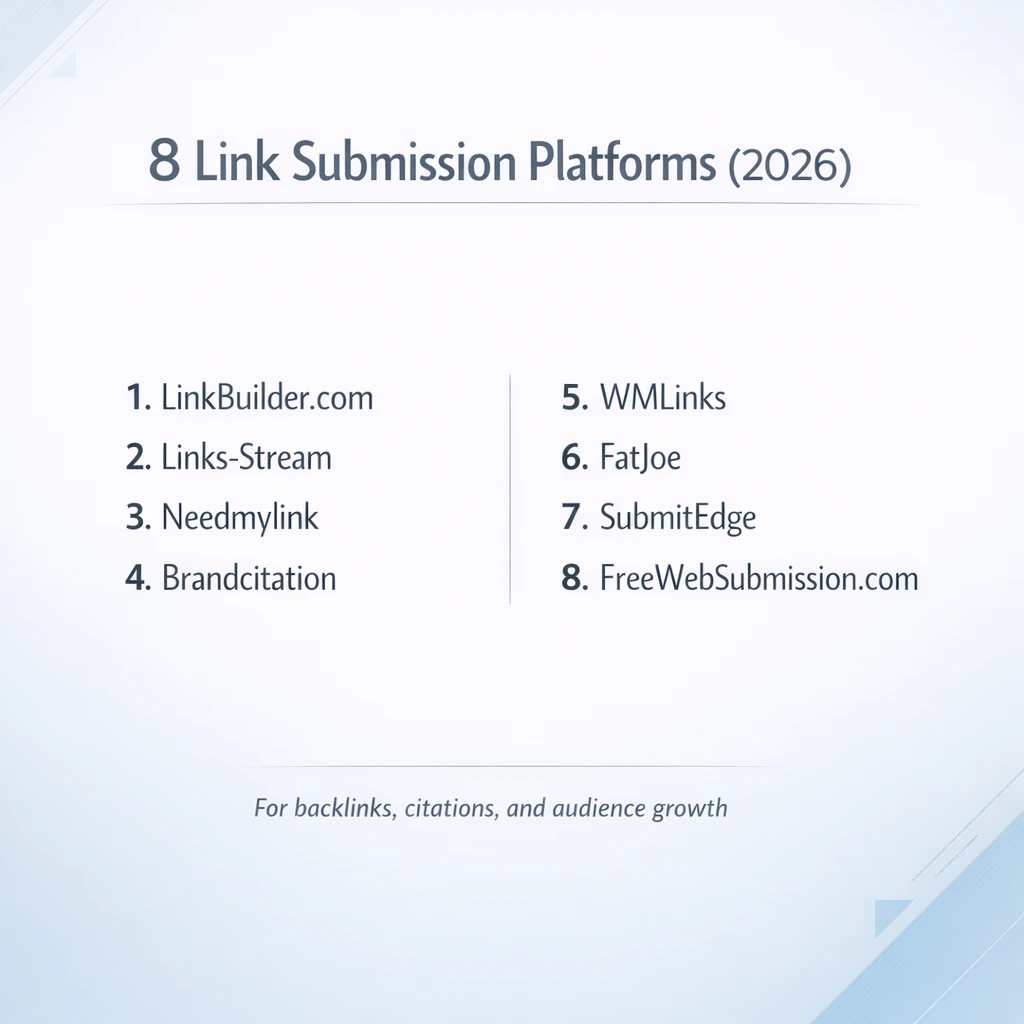
Top 8 Link Submission Platforms to Review
Below are eight platforms worth considering if your business wants to strengthen backlinks, improve discoverability, and support social media growth with a broader web presence.
1. LinkBuilder.com
LinkBuilder.com is one of the better-known names in this space and positions itself as a broad link-building platform rather than a single-purpose submission vendor. Its value is in range and workflow control. The platform highlights access to a large donor database, filtering by region and niche, order management, reporting tools, and support for multiple link-building formats beyond submissions alone.
For companies that want more than just basic directory placements, that flexibility matters. It can be useful if your brand is combining submission links with forum placements, guest posts, profile links, or broader outreach. That is especially relevant for businesses that want backlinks not only for rankings, but also for reputation and discoverability around brand terms.
Best fit: businesses that want a broader link-building workflow and more filtering control.
Why it helps social presence: better brand discoverability across web properties can reinforce trust when people search you after seeing your social profiles.
2. Links-Stream
Links-Stream offers link submissions alongside other promotion services such as guest posting, forum posting, and links from platforms like Quora and Reddit. That makes it more of an agency-style option for brands that want multiple tactics under one roof.
The tradeoff is that entry packages may be less attractive to smaller brands or teams testing this channel for the first time. Still, businesses with a more structured campaign and a need for scale may find its bundled approach useful, especially if they want to combine submission links with discussion-based visibility on external communities.
Best fit: teams planning larger campaigns across several off-page channels.
Why it helps social presence: combining submissions with conversation-led platforms can increase brand touchpoints beyond your owned social accounts.
3. Needmylink
Needmylink focuses on article and profile submissions and offers campaign handling either through a dashboard or with direct support from a project manager. That flexibility can be valuable for businesses that want visibility into the work without needing a fully in-house SEO operations team.
Because profile and article-based placements can help diversify a backlink profile, this platform may appeal to brands that are trying to look more naturally present across the web. For companies building a stronger social footprint, that kind of profile diversity can matter. People searching your business want to see that your brand appears in more than one place.
Best fit: brands that want submission diversity and a choice between self-service and managed support.
Why it helps social presence: article and profile placements can support branded search confidence and improve off-platform validation.
4. Brandcitation
Brandcitation has been known primarily for crowd-marketing and a mix of link types including forum links, social media links, directory links, and link insertions. That makes it especially interesting for businesses that understand that visibility is not only about standard directory placement. It is also about being present in the kinds of online spaces where users research, compare, and discuss services.
The platform’s workflow centers on a dashboard and approval process, which can be helpful if your team wants oversight and revision opportunities. For brands that care about how they appear in public-facing environments, that extra layer of review is valuable.
Best fit: companies that want a broader mix of citations, discussions, and social-context placements.
Why it helps social presence: it supports the idea that your brand should exist across multiple digital conversations, not only on your own channels.
5. WMLinks
WMLinks positions itself around building backlink profiles across many niches and highlights strategy, donor selection, and project management. For companies in competitive or difficult sectors, this can be appealing because not every industry can rely on generic directories or basic submissions alone.
A platform like this can make sense when your submission strategy needs to align with broader link-building logic. If your business is already investing in social media growth and paid promotion, you do not want off-page SEO handled carelessly. You want placement quality to match the rest of your brand effort.
Best fit: businesses in competitive niches or agencies outsourcing link-building operations.
Why it helps social presence: stronger overall authority makes your website and brand assets more credible when social users research your company.
6. FatJoe
FatJoe is widely recognized as a scalable provider in SEO and content services, with strong appeal for agencies thanks to its white-label model. It also offers local citation and submission-related services, which makes it relevant for location-based businesses or agencies managing multiple client brands.
Its process-driven structure is helpful for teams that want standardized deliverables and less internal admin. For social media teams supporting local brands, the local citation angle is particularly important. A business that is active on social but missing from local listings can lose trust at the exact moment potential customers try to verify it.
Best fit: agencies, local businesses, and teams that need repeatable fulfillment.
Why it helps social presence: local citations support trust, map visibility, and conversion after users discover your brand through social content.
7. SubmitEdge
SubmitEdge offers both citation-building and broader directory submission options, making it one of the more straightforward choices for businesses that want to separate local visibility from general online presence. That distinction is useful. Not every company needs the same kind of submission mix.
If your business has a local component, citation consistency should be treated as a core growth asset, not an afterthought. If your brand is more digital-first, broad directory visibility may still support indexing and trust signals. SubmitEdge’s split between local and directory-focused services makes that easier to plan around.
Best fit: businesses that want a clear distinction between local citation building and wider submission campaigns.
Why it helps social presence: local and brand listings can improve conversion confidence after a social click or brand search.
8. FreeWebSubmission.com
FreeWebSubmission.com earns a place on this list because it serves a slightly different need. According to its homepage, it provides free manual and auto submission options to search engines and directories, offers ranked lists of web search engines and local search engines, and includes tools such as a link popularity checker, page speed analyzer, meta tag generator, and search engine saturation tool.
It also highlights local business submission options, monthly website submission, and a low-cost “guaranteed top-10 exposure” offer across its network. For smaller businesses, early-stage websites, or teams trying to improve discoverability without immediately committing to higher-cost campaigns, this can make it an interesting supporting option.
That said, FreeWebSubmission.com should be used strategically. It is better suited as part of a broader visibility plan than as a standalone growth engine. Think of it as a practical layer for search engine discovery, local presence, and supplementary submissions, especially if your brand is still building its digital footprint.
Best fit: small businesses, newer websites, and teams that want an entry-level submission layer.
Why it helps social presence: stronger search engine and local listing visibility can help validate your brand when people move from social discovery to business research.
How to Choose the Right Platform
The best platform is not automatically the biggest list or the cheapest rate. The right choice depends on your goals.
- If you want broader off-page strategy: consider platforms that combine submissions with guest posting, crowd links, or profile placements.
- If you want local visibility: prioritize citation-oriented services and local business listings.
- If you want better brand verification for social traffic: focus on profile quality, business consistency, and reputable placements.
- If you are testing the channel: start with smaller, measurable campaigns before scaling volume.
- If you manage multiple brands: dashboards, reporting, and approval workflows become more important.
A good vendor should make it easier to answer basic questions: Where was the link placed? Is the platform relevant? Was the placement moderated? Can the result be reported clearly? If those answers are hard to get, the campaign will be hard to trust.
A Smarter 90-Day Growth Plan
If your company wants to use submissions without falling into outdated SEO habits, use a phased approach.
Month 1: Build your brand foundation
- Audit your website and key landing pages.
- Standardize your company description, branding, and contact details.
- Claim or improve your major social profiles and business listings.
- Publish one strong evergreen article worth linking to.
Month 2: Add selective submissions and citations
- Choose a platform aligned with your market and campaign size.
- Start with relevant, moderated placements.
- Build local listings if local intent matters to your business.
- Track branded search volume and indexation changes.
Month 3: Connect SEO signals with social campaigns
- Promote your evergreen content through social media.
- Use social engagement to drive traffic to pages that can earn links.
- Measure referral quality, assisted conversions, and branded searches.
- Expand into stronger content partnerships or guest posting if results justify it.
This approach keeps submissions in the right role: a support system for authority and discoverability, not a shortcut meant to do everything on its own.
Common Mistakes to Avoid
- Submitting to everything: more is not better if quality is weak.
- Ignoring social profile consistency: mismatched brand data reduces trust.
- Sending links to weak pages: your target page still needs value.
- Expecting instant rankings: submission work compounds over time.
- Separating SEO from SMM: your audience sees one brand, not two departments.
The strongest digital brands understand that search visibility, social discovery, and trust-building are part of the same customer journey. Someone may first encounter you in a feed, then validate you through search, then convert on your site. If your business is missing from that middle step, growth becomes much harder than it should be.
Final Thoughts
Link submission platforms still have a role in 2026, but only when used with intention. They are not replacements for content, brand strategy, or community engagement. They are support infrastructure. They help search engines find you, help users trust you, and help your business look more established across the web.
For companies serious about social media growth, that matters. Building an audience is not only about publishing more posts. It is also about becoming easier to discover, easier to verify, and easier to trust. Backlinks, citations, profile listings, and search visibility all contribute to that outcome.
If your brand wants to grow both authority and audience, the winning move is not choosing between SEO and social media. The winning move is connecting them. A strong submission strategy, paired with high-quality content and consistent social execution, can do exactly that.
Frequently Asked Questions
Are link submission platforms still effective for SEO?
Yes, when they are used selectively and focused on relevant, moderated, and trustworthy platforms. Quality matters far more than raw submission volume.
Do link submissions help social media growth directly?
Not in the same way social content drives engagement, but they help indirectly by improving brand discoverability, trust, and branded search visibility after someone finds you on social media.
Should small businesses use FreeWebSubmission.com?
It can be a useful supporting option for smaller brands or newer websites that want additional discovery and local listing visibility, especially when used as part of a larger growth strategy.
What is the biggest mistake businesses make with submissions?
The biggest mistake is treating submissions as a standalone growth hack instead of integrating them with content, technical SEO, and social media strategy.
What should I optimize first: backlinks or social media profiles?
Start with your core brand assets first: website, key landing pages, and official social profiles. Then use backlinks, citations, and submissions to reinforce that foundation.