
For years, social media management platforms were judged by one simple promise: could they help teams schedule and publish content across multiple channels from one dashboard?
At the time, that was a real innovation. Tools like traditional Social Media Marketing helped businesses reduce some of the friction involved in managing multiple social accounts. Instead of logging into each platform separately, marketers could centralize scheduling, monitor activity, and maintain a more organized publishing process.
But the marketing environment these platforms were built for no longer exists.
Today’s enterprise marketing teams are not just trying to publish content. They are trying to operate at the speed of a constantly moving news cycle, support more platforms, create more content formats, align across more internal stakeholders, and produce higher-quality output without burning hours on repetitive manual tasks. That shift has changed what a social media management platform needs to be.
And that is exactly where traditional tools are starting to fall behind.
The problem is not that the older model never worked. The problem is that it was built for a different era — one where a social media manager manually wrote each caption, resized each image, toggled between browser tabs, checked character limits, tracked publishing schedules separately, and still had enough time left in the day to think strategically. For many teams, that workflow has become unsustainable.
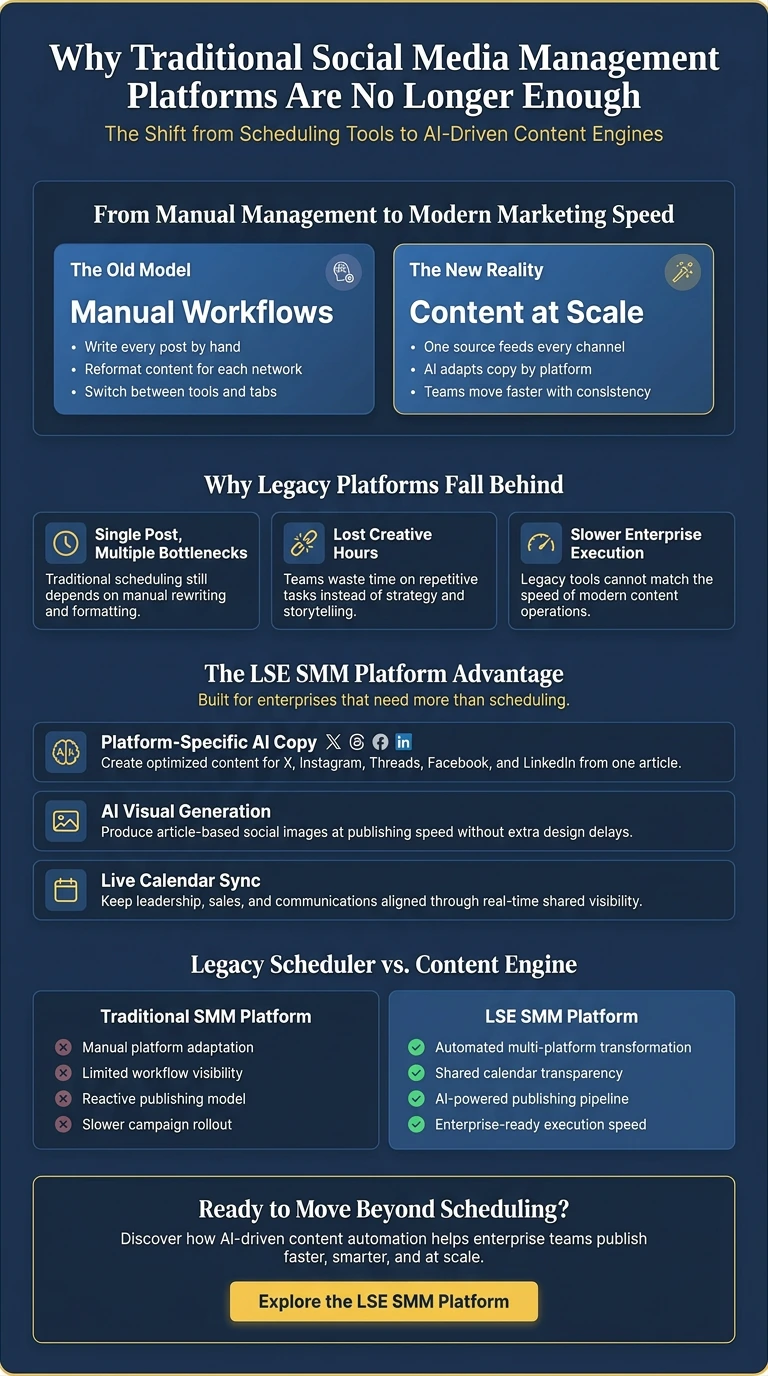
What enterprises need now is not another scheduling interface.
They need a content engine.
They need a system that can take one authoritative source of content and intelligently transform it into a coordinated, platform-ready campaign. They need AI not as a marketing gimmick, but as an integrated workflow layer that removes manual bottlenecks. They need visibility that reaches beyond the marketing department. And they need infrastructure that is built for scale, security, and speed.
At LSE Group, we built the LSE SMM Platform to challenge the limitations of legacy social media management software. And with the rollout of our nodemation pipeline for Enterprise customers, we are redefining what a modern social media management solution should actually deliver.
The real problem with “schedule and publish”
Traditional SMM platforms solved a distribution problem.
They allowed teams to queue content, connect multiple profiles, and publish from a centralized dashboard. But in most cases, the work behind the post remained stubbornly manual. The platform helped you press publish. It did not remove the heavy lifting that came before it.
That distinction matters more than ever.
In a modern enterprise environment, content operations are rarely limited by the ability to publish. They are limited by everything that has to happen first:
- writing platform-specific copy
- adapting tone by channel
- shortening or expanding captions to meet format constraints
- resizing or redesigning supporting visuals
- logging scheduled items across internal calendars
- communicating campaign timing to leadership, sales, and communications teams
- maintaining consistency across all active channels
This is where traditional tools begin to reveal their age.
The workflow is still largely human-dependent. The scheduler may be centralized, but the execution is fragmented. Teams still spend valuable time repeating essentially the same task in slightly different ways for different platforms. Instead of building momentum, marketers get trapped in a cycle of reformatting, checking, adjusting, and manually coordinating.
That is not scale. That is overhead.
And when the pace of business accelerates, overhead becomes a liability.
Enterprise teams do not need another dashboard. They need output at scale.
A modern enterprise marketing team is expected to do far more than simply maintain an active presence on social media.
It has to respond quickly to new developments, support internal campaigns, align messaging across multiple business units, and turn website content into cross-platform distribution assets. In many organizations, speed is no longer optional. The ability to react to market changes, publish quickly, and maintain a polished brand presence across multiple networks is now part of the competitive advantage.
That creates a very different requirement from what legacy SMM tools were originally designed to support.
The old model assumes that a human will sit down and manually transform one idea into many different outputs. The new model requires that transformation to happen automatically, consistently, and intelligently.
This is the difference between a scheduler and a content engine.
A scheduler helps you place content on a calendar. A content engine helps you create, adapt, organize, distribute, and expose content across the full marketing workflow.
That difference is not minor. It changes the entire role of the platform.
One article. Every platform. Zero manual reformatting.
This is exactly what the LSE SMM Platform nodemation pipeline was built to solve.
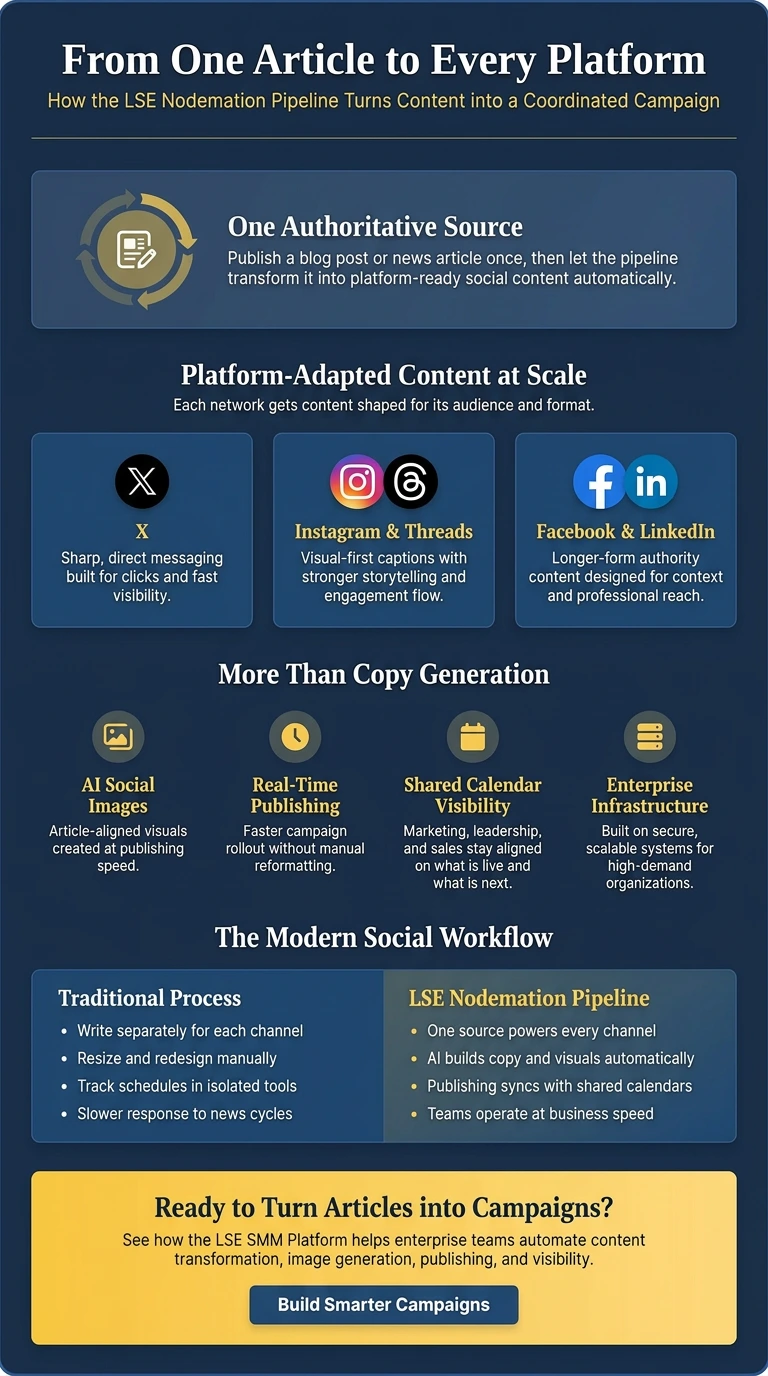
When your team publishes a blog post or news article on your company website, that article becomes the single authoritative content source. From there, the system automatically transforms it into platform-adapted social content across major networks — without forcing your team to manually rewrite each version from scratch.
Instead of starting over for every channel, your enterprise can publish once and distribute intelligently.
Each variation is generated with the needs of the specific platform in mind:
- X receives tighter, sharper copy built for quick visibility and click-through intent
- Instagram and Threads receive more visual-first, engagement-oriented caption formats
- Facebook and LinkedIn receive longer-form variants suited for authority, context, and professional reach
This is not simple truncation. It is not taking one caption and cutting it down until it fits.
The difference between content that performs and content that disappears is often in the wording, rhythm, and structure of the message. Each platform rewards different behavior, audience expectations, and content flow. The nodemation pipeline is designed to account for that reality by generating platform-aware copy that reflects tone, format, and audience behavior.
For enterprise teams, this means one source can drive a complete, coordinated campaign — faster and with far greater consistency than a manual workflow can realistically support.
AI-generated visuals at publishing speed
Copy is only half the job.
The reality of modern social media is simple: visual content determines whether many posts get noticed at all. Even strong messaging can be undermined by delayed design support, inconsistent graphics, or rushed visual execution. In traditional workflows, this often means marketers either search for stock images, open yet another design tab, or wait for internal creative resources to catch up.
That delay adds friction to every campaign.
The nodemation pipeline removes that bottleneck by pairing content transformation with AI-powered social image generation. When an article is processed, the system can also generate article-aligned visuals that support the subject matter and publishing workflow.
This matters because it changes how fast a complete campaign can be deployed.
Instead of treating text and imagery as separate production problems, the workflow becomes integrated. The content source drives the messaging and the visual support at the same time. The result is a more professional and more scalable social presence — especially for businesses that need to move quickly across multiple channels.
No unnecessary stock-photo hunting.
No fragmented design handoff.
No manual scramble to “find something to post with it.”
Just coordinated content output at business speed.
The calendar problem legacy tools still have not solved
One of the most overlooked weaknesses of traditional social media management platforms is that they often keep publishing visibility trapped inside the marketing department.
Yes, a team may have an internal dashboard. Yes, the marketing lead may know what is scheduled. But too often, everyone else in the organization remains disconnected from that flow. Leadership does not see what is live unless someone sends an update. Sales does not know what content is going out unless a separate message is shared. Communications teams may be misaligned simply because publishing data lives in a tool they do not actively use.
That is not a software issue in isolation. It becomes an organizational visibility issue.
The LSE SMM Platform addresses this differently.
Every piece of content — whether already published or still scheduled — is reflected in a shared editorial calendar that syncs directly with existing company calendar infrastructure. That means the broader organization can see what has gone out, what is scheduled next, and how the content pipeline is moving forward.
And most importantly, they can see it inside the calendar environment they already use every day.
This is more than a convenience feature. It creates alignment.
When publishing visibility extends beyond marketing, content strategy becomes easier to coordinate across departments. Campaign timing is clearer. Internal teams can act with better awareness. Leadership gains transparency without asking for separate reports. Sales can align outreach with live campaigns. Communications can prepare around the actual publishing timeline instead of working from assumptions.
Legacy tools generally stop at publishing. Modern platforms need to extend into visibility.
Why this matters more in 2026 and beyond
The broader direction of digital marketing is clear: AI is not being added as a side feature. It is becoming part of the infrastructure of execution.
In paid media, search, content operations, and workflow automation, the shift is the same. Systems are moving away from manual configuration as the default model and toward AI-assisted or AI-driven transformation. The question is no longer whether this shift is happening. It is whether a platform is designed to support it properly.
That is why traditional SMM platforms now feel increasingly incomplete.
A tool that only helps schedule content may still be useful at a basic level, but usefulness is no longer the same as competitiveness. Enterprise teams need systems that reduce production drag, scale quality output, and connect publishing to the wider business. If a platform still depends on humans doing the same repetitive transformation work every day, it becomes harder to justify in a world where modern content pipelines can automate those steps intelligently.
This is the real shift.
Social media management is no longer about posting alone. It is about orchestrating content operations.
From isolated posts to coordinated campaigns
The most important strategic difference between legacy SMM tools and the LSE SMM Platform is that one is built around isolated publishing events, while the other is built around coordinated campaign transformation.
A traditional workflow might look like this:
- A blog post is published.
- A marketer writes separate captions for each platform.
- Images are manually found, resized, or created.
- Publishing times are entered into the scheduling tool.
- Internal visibility is handled elsewhere.
- The process repeats from scratch for the next piece of content.
That workflow is familiar. It is also inefficient.
A modern workflow with the nodemation pipeline looks very different:
- A blog post or news article is published once.
- The system ingests it as the authoritative source.
- AI generates platform-adapted copy for each network.
- AI generates supporting social visuals.
- Content is prepared for publishing across channels.
- Publishing status is reflected in a shared synced calendar.
- Teams stay aligned without manual coordination overhead.
This is not just an incremental improvement. It is an operational redesign.
Built for enterprise-grade requirements
For enterprise organizations, automation without infrastructure is not enough.
A modern platform has to meet operational, compliance, and security requirements at the same level it meets marketing needs. That is why the LSE SMM Platform is built on an enterprise-grade foundation, including:
- PCI DSS
- SOC 2
- ISO 27001
- private global infrastructure across multiple data centers
- direct API relationships with all major social media platforms
These are not peripheral details. They determine whether a platform can actually be adopted inside serious organizational environments.
The nodemation pipeline is built on that same foundation. It is not a disconnected AI layer bolted onto an old interface. It is part of a vertically integrated system designed to take content from ingestion to transformation, visual generation, publishing, and calendar synchronization in a single enterprise-ready workflow.
That distinction matters because many tools talk about AI as an enhancement. What enterprises increasingly need is AI as architecture.
The market is changing faster than legacy tools can
The same way other areas of digital marketing are shifting away from rigid manual workflows, social media management is moving toward systems that are adaptive, intelligent, and organization-aware.
Teams that continue relying on legacy tools may still be able to publish. But they will do so more slowly, with more manual effort, and with less coordination than teams using modern automated pipelines.
That gap will only grow.
As enterprise marketing expectations rise, the cost of fragmented workflows becomes more visible:
slower campaign execution
inconsistent messaging
lost creative time
reduced cross-team visibility
unnecessary operational drag
In the past, those inefficiencies were tolerated because there was no better system. Today, there is.
Final thought
Traditional social media management platforms helped solve yesterday’s problem.
But enterprise marketing teams are now dealing with a very different challenge: how to turn one source of content into a fast, coordinated, high-quality, multi-platform campaign without sacrificing control, visibility, or compliance.
That is not a scheduling problem.
That is an infrastructure problem.
And it requires a different kind of platform.
The LSE SMM Platform was built to meet that shift directly. With the rollout of the nodemation pipeline for Enterprise customers, LSE Group is moving beyond the old “schedule and publish” model and into a new category of AI-driven content operations.
Traditional SMM platforms gave teams a place to queue posts.
The LSE SMM Platform gives enterprises a content engine designed to run at the speed of the business.
And as AI-driven content automation becomes the new standard, the real question is no longer whether social media management is changing.
It already has.
The only question now is whether your platform is ready for what comes next.