
Most businesses are pouring money into social media without seeing meaningful returns. If you've been posting consistently, running ads, and engaging with followers but still struggling to connect your efforts to actual revenue, you're not alone.
The truth is, effective social media marketing isn't about doing more. It's about doing the right things with purpose and precision. The brands consistently winning on social aren't the ones with the biggest budgets or the most followers. They're the ones with strategies built around measurable outcomes.
In this post, we're cutting through the noise to bring you proven social media marketing strategies that translate directly into ROI. Whether you're managing an established brand presence or looking to sharpen a strategy that's gone stale, these actionable tactics will help you rethink how you allocate resources, create content, and measure success. From optimizing your platform selection to building conversion-focused content funnels, each strategy on this list is grounded in real performance data. By the end, you'll have a clear roadmap for turning your social channels into reliable revenue drivers.
Why Social Media Marketing Has Fundamentally Shifted in 2026
The rules governing social media marketing have been rewritten from the ground up, and brands still operating on a 2022 playbook are paying a measurable price for it. This is not an incremental evolution; it is a structural realignment that touches every layer of how brands discover, engage, and retain their audiences.
1. Social platforms have overtaken Google as the primary discovery engine. TikTok, Instagram, and YouTube now account for over 60% of product discovery, surpassing traditional search as the default research channel. Gen Z and Millennials routinely turn to short-form video, peer reviews, and tutorial content on social platforms before making purchasing decisions. Brands not optimized for social search, through keyword-rich captions, video-first formats, and question-answering content, are functionally invisible to the next generation of buyers.
2. Volume-driven posting is now a liability, not a strategy. Audiences in 2026 are far more selective, rewarding authentic and genuinely useful content while actively disengaging from brands that flood their feeds with low-value posts. Research indicates that retail brands posting 60 or more times per week grow 45% slower than those posting with clear intent and purpose. Quality of message now determines reach far more than frequency ever did.
3. AI is embedded at every layer of the modern SMM workflow. From automated scheduling and caption generation to hashtag optimization, competitor monitoring, and inbox management, AI has become operational infrastructure rather than a competitive advantage. Businesses using AI-driven video marketing strategies report an 82% increase in ROI compared to those relying on traditional creative methods. Platforms that integrate AI natively across these functions are now the baseline expectation.
4. Community management has become a core retention function. Brands that fail to respond to customers on social face a 73% churn risk, a figure that transforms reactive inbox management into a strategic priority. Social platforms now function as frontline customer service channels, and response speed directly influences both satisfaction scores and long-term loyalty. Ignoring a message is no longer a minor oversight; it is a measurable revenue risk.
5. Multi-platform presence is now a baseline operational requirement. The average user is active across seven to eight social networks daily, and [maintaining consistent brand presence across 10 or more platforms simultaneously](https://jctgrowth.com/why-social-media-marketing-matters-more-than-ever-in-2026/) has shifted from a competitive differentiator to a minimum viable standard. Single-platform strategies leave significant audience segments entirely unreached and expose brands to disproportionate risk if any one platform's algorithm or policy shifts overnight.
1. Make Short-Form Video Your Highest-Priority Content Format
Short-form video has moved from a supplementary tactic to the cornerstone of competitive social media marketing strategy. For the third consecutive year, short-form video ranks as the #1 ROI-generating content format among marketers, with videos under 60 seconds generating 2.5 times more engagement per impression than any other content type. With 91% of businesses now using video as a marketing tool and 57% of marketing budgets carrying a dedicated short-form line item, this is no longer an emerging format. It is the baseline expectation.
Treating short-form as a single unified channel is a strategic mistake that limits performance before a single frame is published. TikTok rewards raw, unpolished authenticity; audiences there respond to creator-style content that feels personal and immediate rather than produced. Instagram Reels, by contrast, performs strongest when visual branding is consistent and aesthetically sharp. YouTube Shorts favors educational hooks that answer a specific question within the first three seconds. Each platform has its own creative contract with its audience, and brands that ignore those distinctions consistently underperform against those that do not.
The production challenge is real but solvable. 71% of marketers report that videos in the 30-second to 2-minute range deliver the best results, and leading teams now operate on a "capture once, distribute many" pipeline: one core shoot exported in 16:9, 1:1, and 9:16 ratios, then paired with platform-specific captions. This approach allows teams to publish across seven or more platforms weekly without proportionally scaling production costs. AI tools have accelerated this further, with 63% of video marketers now using AI to create or edit content, cutting median production costs by roughly 40%.
Brands that have committed to consistent short-form video publishing are outperforming static-first competitors in both organic reach and conversion metrics across Instagram, LinkedIn, and TikTok. The performance gap between video and static imagery widens with each algorithm update, as platforms continue prioritizing formats that drive session time. Platforms like LSE Group Corp's AI-powered omni-channel marketing platform at lumanet.info are built precisely for this multi-platform reality, enabling brands to schedule, optimize, and iterate on short-form content across 10 or more channels from a single dashboard.
2. Treat Social Platforms as Search Engines, Not Just Publishing Channels
Social search is no longer an emerging behavior; it is the dominant discovery mechanism for an entire generation of buyers. Research confirms that 46% of Gen Z and 35% of Millennials now prefer social media over traditional search engines when researching products, with platforms like TikTok and Instagram processing billions of searches every day. A Google internal study found that nearly 40% of Gen Z users turn to TikTok or Instagram instead of Google when looking for restaurants, travel destinations, and product recommendations. For brands still treating their social profiles purely as broadcast channels, this represents a compounding visibility gap that widens with every post left unoptimized.
Optimizing content for social search requires a parallel discipline to traditional SEO, yet most brands dramatically underinvest in it. Keyword-rich captions written in natural search language, descriptive alt text on images, and strategically layered hashtags combining broad and niche terms all function as indexing signals within platform algorithms. TikTok and Instagram rank content based on caption relevance, engagement velocity, and recency rather than domain authority, meaning a brand that posts consistently with well-structured captions builds compounding discoverability over time. Early engagement signals including saves, comments, and shares amplify a post's search reach significantly, which makes community responsiveness a discoverability strategy, not just a reputation one.
Product-focused content formats perform disproportionately well in social search because they match transactional discovery intent directly. Demos, unboxings, how-to videos, and comparison posts answer the specific questions buyers are actively searching for, generating inbound traffic rather than passive scroll engagement. As Neil Patel noted in 2026: "The brands winning attention today aren't just ranking on Google. They're showing up where intent actually starts."
To convert this insight into action, brands should audit their top 10 performing posts and distinguish between content driving inbound discovery traffic and content generating engagement-only interactions. Once discovery-oriented formats are identified, doubling down on that structure, topic framing, and caption style builds a scalable social search presence with measurable returns.
3. Build an Omni-Channel Distribution Strategy Across 10 or More Platforms
Relying on a single platform is one of the most operationally fragile decisions a brand can make in 2026. Algorithm updates, policy changes, and sudden reach compression can collapse months of audience-building overnight. Distributing content across 10 or more platforms simultaneously creates a natural hedge: a reach drop on one channel is absorbed by continued performance across the others. With audiences now fragmented across Facebook, Instagram, TikTok, YouTube, LinkedIn, Pinterest, Reddit, Snapchat, Threads, Bluesky, and X, a multi-channel marketing strategy is no longer a growth tactic — it is a baseline requirement for sustained visibility.
Building this kind of strategy effectively requires more than simply reposting content across channels. Each platform carries distinct format expectations, algorithmic preferences, and audience demographics that demand tailored treatment. A content calendar built for omni-channel execution must map platform-specific formats, posting cadences, and audience personas in parallel. Short-form vertical video performs on TikTok and Reels, while LinkedIn rewards long-form professional insight, and Pinterest prioritizes evergreen visual discovery. Treating these platforms as interchangeable channels produces mediocre results across all of them.
The operational challenge is where most brands stall. Managing 10 or more platforms manually introduces scheduling gaps, inconsistent brand voice, and team burnout. AI-powered unified dashboards solve this directly by centralizing scheduling, publishing, and performance analytics into a single workflow. Lumanet.info's SMM platform supports 10-plus platforms from one dashboard at $199 per month, making enterprise-grade omni-channel management accessible without the cost barrier of platforms priced above $1,000 per month.
Consistency across channels also compounds brand recall in measurable ways. According to 2026 social media statistics, audiences who encounter a brand repeatedly across multiple platforms develop stronger purchase intent than those exposed through a single channel. Every additional touchpoint reinforces recognition and trust, directly supporting conversion. For intermediate-stage brands looking to accelerate growth, omni-channel distribution is the structural investment that makes every other tactic more effective.
4. Prioritize Human-Generated Content Even in an AI-First Workflow
Despite AI becoming the dominant engine for content production at scale, human-generated content remains the number one user preference heading into 2026. Research confirms that audiences have grown measurably more sensitive to formulaic, AI-produced captions and posts, with many brands discovering that high output volume without authentic voice actively erodes engagement rather than building it. The underlying dynamic is clear: AI scales production, but humans supply persuasion and relatability, the two qualities that convert passive scrollers into loyal followers.
The practical resolution most high-performing brands have adopted is a structured hybrid model. AI handles ideation, keyword clustering, scheduling, and first-draft copy, while human editors enforce brand voice, validate factual accuracy, and add the narrative depth that templated output consistently lacks. According to current research on AI versus human content strategy, hybrid human-AI content generates 5.44x more traffic than purely AI-generated content, a figure that makes the operational case for maintaining human oversight at every publishing stage. Teams using this workflow also report a 40% productivity increase, meaning authenticity and efficiency are not competing priorities.
Content format matters as much as content origin. Behind-the-scenes footage, founder-led video, and employee-generated posts consistently outperform polished branded content in organic reach on Instagram and LinkedIn, because platform algorithms reward genuine engagement signals over visually refined but emotionally flat material. As human-first content strategy analysis for 2026 confirms, audiences prioritize authentic voices over production polish when making trust-based decisions about brands.
To operationalize this balance, brands should establish a documented content mix ratio and communicate it explicitly to their social teams. A practical starting framework allocates roughly 60% of output to human-authored content, 30% to AI-assisted content with human review, and 10% to fully automated distribution. This ratio prevents over-reliance on automation while preserving the efficiency gains that make omni-channel management sustainable.
Authenticity also extends beyond content creation into how brands handle public criticism. Transparent, conversational human responses to negative feedback consistently build more long-term trust than polished, scripted brand-voice replies. When 73% of consumers say they will switch brands if ignored on social media, the stakes for genuine engagement are not abstract. Platforms like LSE Group Corp's AI-powered social media management solution are designed to handle the operational complexity of managing responses across 10 or more channels simultaneously, ensuring no message goes unanswered while preserving the human judgment required for sensitive interactions.
5. Scale Influencer Marketing as a Standard Budget Line, Not an Experiment
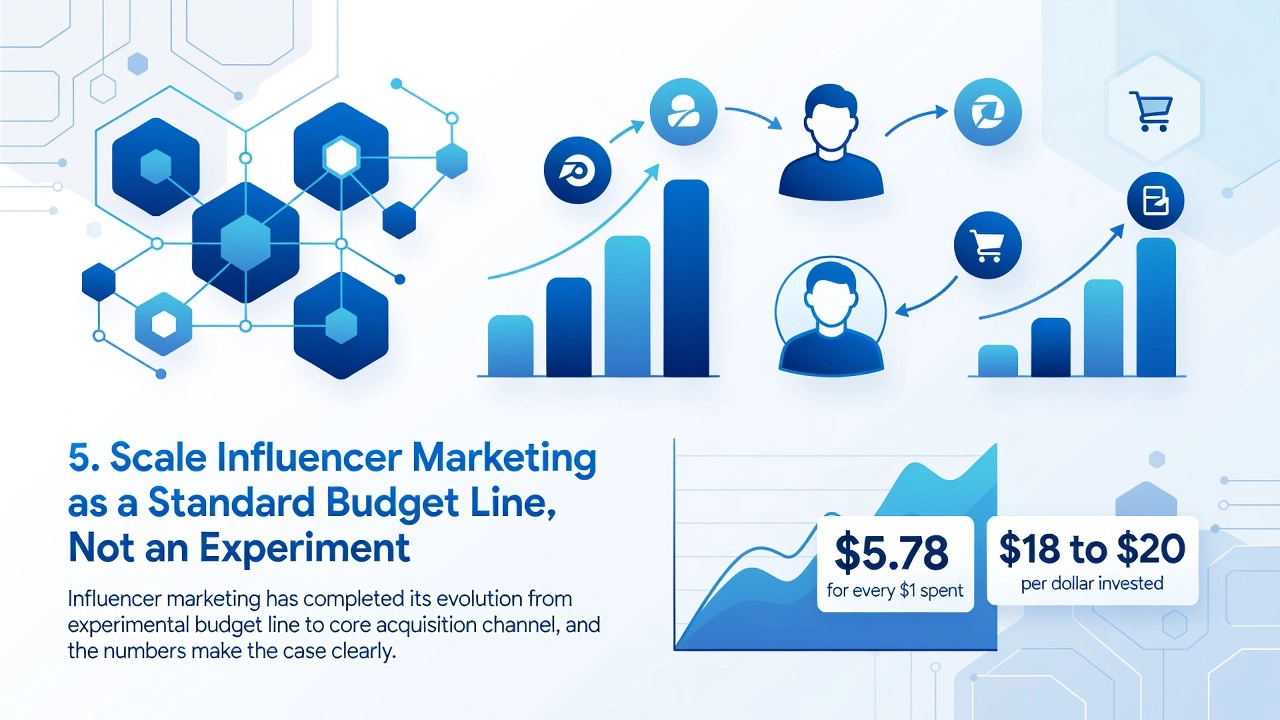
Influencer marketing has completed its evolution from experimental budget line to core acquisition channel, and the numbers make the case clearly. Brands now earn an average of $5.78 for every $1 spent on influencer marketing, with top-performing campaigns reaching $18 to $20 per dollar invested. Influencer content also delivers 11x higher ROI than traditional banner advertising when measured across a 12-month window. With 86% of marketers actively using influencer marketing in 2026 and 67% of brands planning budget increases, this is no longer a channel you test once per quarter. It belongs as a recurring line item alongside paid social and SEO, reviewed and optimized on the same cadence.
The most consistent finding in current influencer marketing budget research is that brands treating it as an ongoing program outperform those running isolated campaigns. A complete influencer budget covers four components: creator fees or gifting, content usage rights (which typically add 20 to 50% on top of base fees and are frequently overlooked), ad spend behind top-performing content through whitelisting or platform-native amplification, and internal management time. Omitting any of these creates budget gaps that distort true cost-per-result calculations.
For most intermediate programs, micro-influencers with 10,000 to 100,000 followers represent the highest-efficiency allocation. They generate an average engagement rate of 3.86% compared to 1.21% for mega-influencers, at 60% lower cost per post. In B2B and technical verticals, this gap is even more pronounced: B2B influencer marketing grew 47% year-over-year, and LinkedIn-first creator campaigns generate 3.2x more qualified leads than comparable paid social spend.
Long-term partnerships compound these gains further. According to 2026 influencer marketing trend analysis, 71% of consumers trust creator recommendations over direct brand messaging, and that trust deepens with repeated exposure. Each successive activation costs less persuasion effort because the audience has already built a relationship with the creator's endorsement of your brand.
Measurement must extend beyond last-click attribution to capture this full value. Deploy UTM parameters on every creator link, issue unique discount codes per creator, and pull platform-native data from branded content tools simultaneously. These three signals triangulate purchase intent across the awareness-to-conversion journey that a single attribution model will always undercount.
6. Treat Community Management as a Customer Retention Function
Community management has a retention consequence that most brands systematically underestimate. Research consistently shows that 73% of consumers say they will switch to a competitor if a brand fails to respond to them on social media, which reframes the entire function from a goodwill exercise into a measurable churn variable. Response speed is not a soft metric; it is a direct indicator of whether a customer stays or leaves.
The data on current brand behavior reveals a significant gap between customer expectations and actual practice. Only 17.6% of brands respond to social media complaints within one hour, while 21.4% rarely or never respond at all. Given that customers increasingly expect near-immediate acknowledgment, operating outside that window represents a competitive vulnerability. Best-practice targets position sub-one-hour first response during business hours and sub-four-hour response for after-hours messages as the thresholds where retention risk drops to acceptable levels.
AI-powered inbox management is what makes those response standards operationally achievable at scale. Modern tools can triage incoming messages by urgency, auto-respond to high-frequency queries, detect sentiment to prioritize escalations, and route complex issues directly to human agents. The result is dramatically reduced response latency without requiring proportional increases in team size.
Lumanet.info's omni-channel platform integrates AI-assisted inbox management as a core component of its $199/month suite, enabling brands to maintain consistent response standards across 10 or more platforms simultaneously. For growing companies managing presence across Instagram, TikTok, LinkedIn, YouTube, and beyond, this centralized capability eliminates the operational overhead that typically forces brands to deprioritize engagement on secondary channels.
Community management also extends beyond reactive support. Proactive behaviors, including commenting on relevant industry conversations, participating in niche communities, and publicly acknowledging user-generated content that features your brand, build reciprocal loyalty that passive publishing cannot replicate. These actions signal genuine presence and reinforce the kind of authentic connection that today's selective audiences actively reward.
7. Use AI to Systematize the Operational Layer of Social Media Marketing
In 2026, AI has matured from a convenience layer into the full operational backbone of high-performing social media marketing programs. The modern AI-powered SMM stack addresses six distinct workflow functions: content scheduling, caption and post generation, hashtag optimization, competitor monitoring, performance analytics, and inbox management. Brands that treat these functions as isolated tasks handled by separate tools are losing ground to those running them as an integrated, automated system.
Automated scheduling based on AI-predicted peak engagement windows has become one of the highest-leverage optimizations available. Rather than relying on generic best-practice posting times, current platforms analyze your specific audience's behavioral patterns across Instagram, LinkedIn, TikTok, Facebook, X, and Pinterest to surface the precise windows where reach-to-effort ratios are strongest. This capability is now a baseline feature, not a premium add-on, meaning brands still posting manually are operating at a structural disadvantage.
Post-generation AI works best as a draft engine, not a ghostwriter with final authority. The most effective brands in 2026 use AI to generate multiple caption variations and hook options simultaneously, feeding them directly into A/B testing pipelines. A practitioner running this model can produce and schedule a full week of content in under an hour. The critical discipline is maintaining human editorial review, especially for brand-sensitive topics, crisis situations, or content requiring nuanced audience context that AI tools cannot yet reliably assess.
Hashtag optimization tools analyze real-time trend and competition data to recommend sets that balance discoverability against saturation, eliminating the manual research cycle that previously consumed hours of strategy time each week.
AI competitor monitoring gives brands continuous visibility into rival posting cadence, content themes, and engagement benchmarks, making both reactive and proactive positioning adjustments operationally practical rather than aspirational. For teams managing 10 or more platforms simultaneously, AI tools for social media marketing consolidate these capabilities into unified workflows that replace disconnected point solutions with a single command layer. LSE Group's AI-powered platform at $199/month is built precisely for this consolidated model, giving growing brands enterprise-level operational infrastructure without the enterprise price tag.
8. Align Your SMM Strategy to Your Company Growth Stage
Your social media marketing strategy should never be static. It must evolve in direct proportion to your company's size, resources, and operational complexity. A single universal approach creates either underinvestment at the startup stage or dangerous operational bottlenecks at the enterprise level.
Startups operate best with deliberate platform concentration. Rather than spreading thin across every channel, early-stage companies should commit to two or three platforms where their specific target audience is most active. A B2B SaaS startup gains more traction on LinkedIn than TikTok; a D2C consumer brand often finds the opposite is true. Peer-reviewed research published in PLOS ONE confirms that social media usage positively impacts startup performance, with authentic brand image acting as the critical mediating variable. This supports an organic-first approach built around founder-led content before allocating budget to paid distribution. AI-powered scheduling tools allow a one or two-person team to maintain consistent posting cadence without hiring a dedicated social team.
Growth-stage companies managing multiple product lines, markets, or audience segments face a different problem entirely. Manual, platform-by-platform management creates analytical blind spots that obscure where budget should flow. This is the stage where unified omni-channel management delivers measurable ROI. Platforms like lumanet.info's $199/month AI-powered solution offer cross-platform management across 10 or more channels with consolidated analytics, providing a cost-effective alternative to scaling headcount. Content should shift toward thought leadership, case studies, and customer proof points that build market authority.
Large enterprises require capabilities that budget tools cannot deliver: multi-user permissions, structured approval workflows, audit logs, and compliance controls that support teams of 50 or more across multiple regions.
Content mix follows this same progression. Startups win with authenticity; growth-stage brands win with credibility-building content; enterprises win with consistent, campaign-led storytelling across every channel simultaneously.
Critically, tooling decisions must be revisited at every major growth inflection point. The lightweight scheduler serving a 10-person startup will create compounding bottlenecks for a 200-person marketing team managing 15 channels across time zones. Identifying those transition triggers early prevents costly platform migrations under pressure.
9. Use Paid Social to Amplify Organic Wins, Not Replace Them
The highest-converting paid social strategy in 2026 is not spending more; it is spending smarter by amplifying content that has already earned its stripes organically. When a post generates strong engagement without paid support, the audience has pre-validated the message, the creative, and the value proposition. Boosting that content eliminates the guesswork from paid distribution and significantly reduces creative risk. With Facebook organic reach averaging just 1.1% to 2.2% per post and LinkedIn sitting between 4% and 8%, paid amplification is no longer optional for brands with distribution goals beyond their existing followers. The discipline lies in sequencing correctly: organic first to validate, paid second to scale.
Platform-native ad formats deliver measurably better results than importing external creative into a social feed. TikTok Spark Ads boost existing organic posts while preserving their original engagement signals, including likes, comments, and shares, which function as social proof that cold creative simply cannot replicate. Instagram Boosted Reels and LinkedIn Thought Leader Ads operate on the same principle, blending seamlessly into the feed experience rather than interrupting it. Audiences are increasingly adept at identifying and scrolling past content that feels like an advertisement, making format authenticity a competitive advantage, not a cosmetic preference.
Retargeting warm audiences consistently outperforms cold prospecting at comparable budget levels. Users who have already engaged with organic content or visited a brand's website carry significantly higher purchase intent. Allocating the majority of paid social budgets toward these audiences while reserving at least 20% for testing new audiences, formats, and messaging frameworks prevents the performance decay that inevitably follows as winning creative fatigues.
Finally, attribution models must evolve alongside the formats brands are investing in. Last-click attribution systematically underreports the value of short-form video and other upper-funnel formats. View-through conversions and assisted conversions need to be factored into performance reporting to accurately measure how paid social contributes to the full customer journey.
10. Measure Unified ROI Across All Platforms From a Single Dashboard
Platform-native analytics are siloed by design. Instagram Insights, TikTok Analytics, and LinkedIn's native reporting each define core metrics differently; "reach" on TikTok is not the same calculation as "reach" on Instagram, and "engagement" on LinkedIn encompasses behaviors that other platforms don't count at all. Brands relying exclusively on these native tools are not conducting cross-platform analysis; they are comparing incompatible data sets and drawing budget decisions from fundamentally unreliable comparisons. With B2B marketers now allocating nearly 28.5% of total budgets to social media, that measurement gap carries real financial consequences.
A unified analytics dashboard solves this by normalizing metrics across all channels into a single, comparable reporting layer. Rather than toggling between six platform dashboards, your team sees aggregated reach, engagement, conversion rates, and response-time data side by side. This cross-channel visibility transforms what is otherwise a fragmented guessing exercise into a structured, data-driven allocation decision. When LinkedIn is consistently delivering a 200%+ ROI and a secondary platform is underperforming at half that rate, the reallocation case becomes clear and defensible.
The core omni-channel KPIs your unified dashboard must track include engagement rate by platform, follower growth velocity, response rate and average response time, click-through rate to owned assets, and attributed pipeline or revenue. Critically, only 30% of marketing leaders currently report they can measure social ROI with confidence, making this infrastructure a genuine competitive differentiator rather than a standard practice.
AI-generated performance reports, such as those produced through the lumanet.info platform, take unified reporting a step further by surfacing anomalies automatically. A sudden 40% drop in organic reach, a spike in negative sentiment around a product keyword, or an unusual surge in competitor mentions can all be flagged within the reporting cycle rather than discovered two weeks later during a manual review.
Establish a firm monthly cross-platform performance review cadence using this unified data. Each session should produce three outputs: an updated content mix decision, a revised posting frequency by channel, and a paid budget reallocation recommendation. This cadence converts your dashboard from a passive reporting tool into an active strategic engine.
11. Adapt SMM Strategy for B2B and Technical Industries
B2B social media marketing operates on a fundamentally different timeline than B2C. Where consumer brands can drive purchase decisions within a single scrolling session, B2B buyers move through extended evaluation cycles involving multiple stakeholders, internal approvals, and significant due diligence. Research confirms that nearly 60% of business decision-makers have directly awarded business to an organization based on its thought leadership content, and 55% report increasing spend with an existing provider specifically because of that provider's published insights. This means LinkedIn thought leadership, educational case studies, and expert-driven content are not brand-building luxuries; they are direct pipeline inputs that outperform promotional posts at every stage of the buyer journey.
Technical industries present a compounding challenge: the products themselves are complex, the buying committees are specialized, and the sales cycles can span months. Educational short-form video addresses this directly. A 60-second explainer on how a vertical axis wind turbine performs under variable wind conditions, or how a layered IT security architecture protects distributed endpoints, does three things simultaneously: it demystifies the offering, builds category awareness among buyers who are still defining their requirements, and generates qualified inbound interest from audiences who self-select through the content.
LinkedIn remains the dominant platform for direct B2B pipeline generation, recording 1.4 billion monthly visits as of February 2026, with 62% of B2B marketers reporting it delivers leads at twice the rate of other platforms. However, YouTube and TikTok are increasingly effective for building trust in technical verticals, particularly as younger procurement influencers enter decision-making roles and conduct early-stage research through video-first discovery.
Account-based social strategies, where content is tailored to specific target accounts and distributed through employee advocacy rather than broadcast corporate posting, deliver measurably stronger engagement because they replace generic reach with targeted credibility signals. Lumanet.info serves clients across IT security, 3D engineering, and renewable energy, and its AI-powered platform supports the consistent, multi-platform educational presence these verticals require to build the authority necessary for winning complex, high-value sales.
12. Integrate Social Media Management With Your CRM and Business Operations
Disconnected social media and CRM data is one of the most underreported sources of marketing waste in 2026. When social engagement lives in a separate silo from your lead records and sales pipeline, your team has no reliable way to determine which comments, DMs, or link clicks contributed to actual revenue. Go-to-market teams consistently struggle to trace which campaigns and content drive real conversions, and that problem becomes structurally unsolvable when social data never enters the CRM in the first place.
Integrating your SMM platform with a CRM or ERP system closes this gap by creating a direct link between social interactions and business records. When a prospect sends a DM or clicks a tracked link, that touchpoint can be attributed to a lead record and mapped to a pipeline stage. This enables multi-touch attribution reporting that demonstrates social media's contribution to revenue in terms leadership can act on. Teams using CRM-integrated attribution tools report reducing customer acquisition costs by 20 to 40 percent by eliminating wasted spend and scaling the channels that demonstrably convert.
For businesses already running Odoo as their core ERP and CRM, this integration challenge has a purpose-built solution. LSE SMM and LDAPS for Odoo 17 and 19, available through the lumanet.info online shop, connect social media management directly into Odoo's native business workflow. This is a capability that mainstream SMM platforms do not address at the ERP module level. Without this integration, Odoo users are left manually exporting social leads and importing them into CRM records, a process that introduces data errors, delays lead response time, and inflates reporting overhead.
The broader principle extends to any SMM stack. The more tightly social data is wired into CRM, e-commerce, and customer service systems, the more precisely brands can measure and continuously optimize social media's actual contribution to business outcomes.
13. Build a Content Calendar That Enforces Consistency at Scale
Posting consistency is not a scheduling preference; it is an algorithmic signal. Platforms including Instagram, TikTok, and LinkedIn are designed to reward accounts that publish on a reliable cadence and systematically deprioritize those that post in bursts followed by extended silence. Research shows that 73% of marketers miss their intended posting cadence, and calendar structure, not content quality, is the primary failure point. A sustainable schedule of two to three posts per week, maintained over twelve months, will outperform an aggressive launch-month output that trails off by week six. The takeaway is direct: optimize for long-term reliability, not short-term volume.
A well-constructed content calendar removes the daily creative decision entirely. By mapping content pillars to specific days and platforms in advance, such as educational content on Tuesdays, promotional content on Thursdays, and community-focused content on weekends, teams can execute with precision rather than improvisation. This pillar-based structure produces a balanced content mix across your full platform portfolio and ensures no single content type dominates the feed at the expense of audience relationship-building.
Batching content creation is the operational practice that makes the calendar sustainable at scale. Rather than producing content daily, high-performing teams dedicate a single session every two to four weeks to ideation, writing, graphic creation, and scheduling in one continuous workflow. This reduces context-switching, prevents the burnout that 33% of social practitioners cite as their greatest professional fear, and consistently produces higher-quality output than reactive, day-of content.
AI-powered scheduling tools add a precision layer by analyzing historical engagement data to recommend the optimal posting window for each platform independently, improving organic reach without requiring additional content volume.
Reserve 20 to 30% of your calendar capacity as an unscheduled buffer. Trend responses, breaking news commentary, and real-time community engagement cannot be pre-produced, but they must be operationally planned for. Teams that pre-assign ownership of reactive content, and protect time for it within the weekly workflow, execute it far more effectively than those treating it as an afterthought.
14. Choose the Right SMM Platform for Your Budget and Scale
The SMM platform market in 2026 spans from free-tier tools to enterprise suites exceeding $1,000 per month, and the gap between tiers is significant in both capability and cost. Selecting the right platform requires honest assessment of four variables: platform coverage, AI capabilities, analytics depth, and team size. With the global social media management market projected to reach $39.14 billion in 2026 and growing at a nearly 20% CAGR, the vendor landscape is expanding rapidly, making informed selection more important than ever.
Free tier: Metricool covers Instagram, TikTok, YouTube, LinkedIn, Threads, Pinterest, and Google Business Profile at no cost, making it a credible entry point for early-stage brands operating on constrained budgets. It includes a content planner, basic inbox management, hashtag tracking, and an AI post generator. However, its analytics depth, automation capacity, and multi-account limits are constrained relative to paid platforms. Solo operators and micro-teams can use it productively, but brands managing active community programs or multiple accounts will outgrow it quickly.
Mid-to-enterprise tier tools offer significantly deeper analytics, stronger AI scheduling capabilities, and broader integration ecosystems. Research indicates AI scheduling tools increase engagement 25 to 40 percent compared to fixed-time posting. However, per-seat pricing models at this tier scale steeply as team headcount grows, making these platforms cost-prohibitive for startups and lean marketing teams that need multi-platform coverage without a large recurring seat cost.
Enterprise tier platforms are purpose-built for organizations managing 20 or more accounts with complex approval workflows, compliance requirements, and governance controls. These are appropriate for regulated industries and large distributed marketing teams, but the pricing and onboarding complexity make them impractical for most growing companies.
Lumanet.info's SMM platform at $199 per month addresses the underserved middle tier directly. It delivers AI-powered omni-channel management across 10 or more platforms at a price point that growing companies and lean enterprise teams can sustain without per-seat escalation. For organizations that have outgrown free tools but cannot justify enterprise-level investment, it represents a structurally sound alternative built for exactly this growth stage.
15. Use Social Listening to Turn Competitor Intelligence Into Strategic Advantage
Social listening has evolved well beyond tracking brand mentions. In 2026, it functions as a full-spectrum competitive intelligence discipline that informs content strategy, product messaging, audience targeting, and crisis response simultaneously. The global social listening market was valued at USD 8.44 billion in 2024 and is projected to reach USD 16.19 billion by 2029, a growth trajectory that reflects how seriously organizations now treat this capability. With 62% of marketers actively using social listening tools, the practice has crossed from early-adopter territory into standard operational practice across organizations of every size.
Competitor monitoring is one of the highest-value applications of social listening. By tracking rival brands across platforms, marketing teams can map posting cadence, identify top-performing content formats, and benchmark audience engagement rates against their own. This data reveals where competitors are underserving their audiences, creating clear openings for brands willing to fill those gaps with better-targeted or more consistent content.
Tracking unbranded industry keywords amplifies this advantage further. Monitoring conversations around phrases like "best renewable energy solutions" or "IT security for startups" surfaces audiences actively seeking guidance before they have attached to any specific brand. This approach builds organic awareness without promotional content, inserting a brand into high-intent conversations at exactly the right moment.
Sentiment monitoring adds a critical risk-management layer. Brands with structured listening processes detect and respond to emerging negative signals 4.3 times faster than those without, a meaningful edge when a single viral post can reshape brand perception overnight. Monitoring sentiment during product launches and industry news cycles allows teams to address narratives before they escalate.
AI-powered listening tools now classify sentiment, flag trending topics, and generate recommended response templates in real time. Manual monitoring processes cannot operate at the speed or scale that modern social platforms demand, making AI-native listening tools a non-negotiable component of any competitive social media marketing stack in 2026.
Conclusion: Building a Social Media Marketing Engine That Compounds Over Time
Social media marketing has completed a fundamental transformation. What once qualified as a marketing side project, measured loosely by likes and follower counts, is now a data-driven, omni-channel business function with traceable revenue impact. The 15 strategies covered in this guide reflect that shift, moving from tactical posting toward a disciplined system built on clear KPIs, consistent cadence, and unified platform intelligence.
Three actions deliver disproportionate returns above all others. First, prioritize short-form video; it generates 41% ROI, the highest of any content format. Second, respond to customers within benchmarked time windows, because 73% of consumers will leave for a competitor if ignored. Third, consolidate platform management into a single AI-powered tool that eliminates the operational drag of fragmented dashboards.
Brands winning on social in 2026 treat it as a core business function with dedicated tooling and accountability. Teams ready to make that transition can start at lumanet.info, where AI-powered omni-channel management across 10 or more platforms begins at $199 per month.
The compounding nature of social presence is real. Brands that invest consistently today build discoverability, trust, and audience equity that competitors who wait simply cannot buy back later.